Tag: brand management

  • 5 Pillars of Successful Corporate Rebranding Signage: A Strategic Checklist

    5 Pillars of Successful Corporate Rebranding Signage: A Strategic Checklist

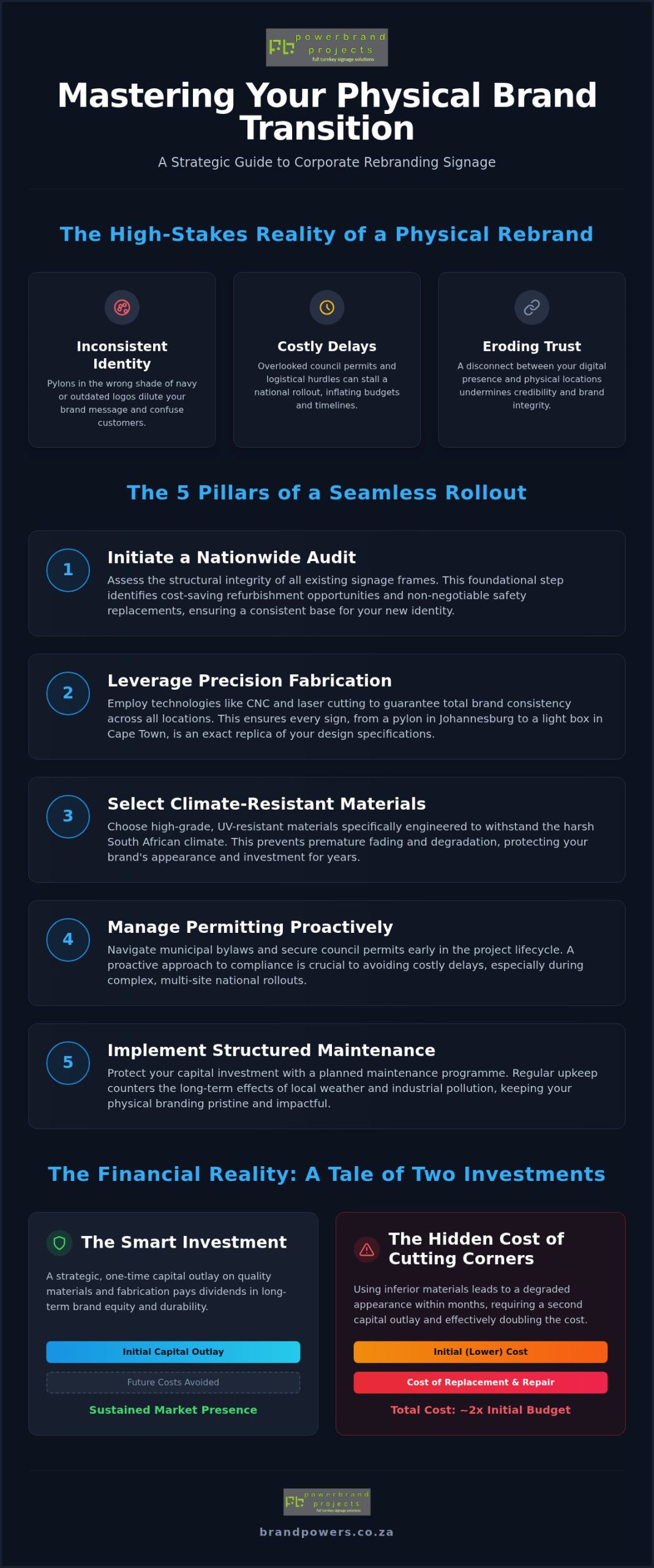
    Imagine the frustration of unveiling a multi-million Rand brand identity only to discover that your physical locations tell a different story. Perhaps the primary pylon at your Johannesburg branch is the wrong shade of navy; or a crucial installation in Cape Town is stalled because of overlooked council permits. These inconsistencies don’t just dilute your message; they erode the trust you’ve worked hard to build. Successfully managing corporate rebranding signage requires more than just a new logo; it demands a meticulous marriage of creative vision and technical manufacturing precision.

    We understand that the logistics of a national rollout are daunting, especially when you’re balancing the high costs of external fabrication with strict project deadlines. It’s a high-stakes transition where there’s little room for error. This professional guide provides a strategic checklist to help you master the complexities of your physical brand transition. We’ll examine the essential pillars of auditing, fabricating, and installing your new identity to ensure a seamless, durable result. You’ll learn how to navigate the turnkey process from initial design to long-term maintenance, ensuring your investment remains protected for years to come.

    Key Takeaways

    • Initiate a nationwide audit to assess the structural integrity of existing frames and ensure a consistent foundation for your new visual identity.
    • Leverage precision CNC and laser cutting technologies to ensure total brand consistency across all corporate rebranding signage.
    • Select high-grade, UV-resistant materials specifically engineered to withstand the harsh South African climate and prevent premature fading.
    • Proactively manage municipal bylaws and council permitting early in the project lifecycle to avoid costly delays during multi-site rollouts.
    • Implement a structured maintenance programme to protect your capital investment from the long-term effects of local weather and industrial pollution.

    The Strategic Role of Corporate Rebranding Signage

    Corporate rebranding signage serves as the primary physical manifestation of a company’s renewed identity. While digital assets like websites and social media profiles are updated with a few keystrokes, the physical environment requires a more deliberate, tangible transformation. This physical presence acts as the anchor for a corporate rebranding strategy; it provides the public with a concrete signal that change has occurred. When a massive pylon or a sleek building-top light box is unveiled, it translates abstract values into a visible reality that clients and stakeholders can see. It’s the most public-facing commitment a business makes to its new direction.

    The psychological impact of this transition is profound. For employees, arriving at a workplace that displays modern, high-quality signage reinforces a sense of purpose and forward momentum. It signals that the organisation is investing in its future. For clients, professional physical branding establishes immediate credibility. If the digital experience is modern but the physical signage is faded or outdated, it creates brand drift. This disconnect breeds confusion and suggests a lack of attention to detail, which can undermine the entire rebranding investment. Consistency across all touchpoints is essential to maintain the integrity of the new visual language.

    Beyond the Logo: Communicating Values

    High-quality signage does more than display a name; it communicates the brand’s character through material and light. Opting for 3D fabrication or premium metal finishes suggests a brand that values durability and excellence. Choosing specific illumination techniques, such as halo-lighting or modern LED-backed acrylic, can signal a shift toward a more innovative or tech-forward direction. Beyond aesthetics, signage plays a critical role in wayfinding. It guides people through the physical space of the new corporate culture, ensuring that every touchpoint feels cohesive and intentional.

    The Financial Reality of Physical Branding

    In many large-scale transitions, the implementation of corporate rebranding signage accounts for the largest single portion of the identity budget. This is particularly true for South African firms with a national footprint across multiple provinces. Cutting corners with cheap materials often leads to rebranding failure. Inferior vinyls or non-UV-resistant plastics quickly succumb to the harsh local sun, leading to a degraded appearance within months. A poor-quality sign that peels or fades requires a second capital outlay, effectively doubling the cost. The ROI of signage is found in long-term brand equity; a durable, well-executed installation preserves the brand’s premium perception for years, justifying the initial investment through sustained market presence. Selecting a partner from among the best signage companies South Africa has available is therefore a critical strategic decision that directly influences this long-term return.

    Conducting a Comprehensive Signage Audit and Site Survey

    Before a single sheet of vinyl is cut or a laser begins its work, a meticulous inventory of all physical assets is required. This phase is the foundation of any successful transition. For companies with a national footprint, this involves more than a simple headcount of office locations; it requires a detailed survey of every pylon, billboard, and internal wayfinding sign across the country. By conducting a comprehensive signage audit, a business can identify exactly what exists and, more importantly, what condition those structures are in.

    Assessing the structural integrity of existing pylons and billboard frames is a critical cost-saving measure. If a frame is sound, a simple face-lift or refurbishment may suffice. However, if rust or metal fatigue has set in, replacement is a non-negotiable safety requirement. During this process, identify high-visibility priority zones. These are the locations where your corporate rebranding signage will have the most significant public impact, such as main entrance pylons or building-top light boxes. These areas should be prioritised in the rollout schedule to ensure the new identity is visible where it matters most.

    The 5-Step Audit Framework

    A structured approach ensures no detail is overlooked. Follow these steps to categorise and evaluate your assets:

    • Step 1: Categorise by type. Group assets into external signage, internal branding, and wayfinding to understand the scale of each requirement.
    • Step 2: Evaluate condition. Determine which signs require total replacement and which can be refurbished to extend the life of the existing hardware.
    • Step 3: Map the customer journey. Walk through the site from the perspective of a visitor to ensure the new branding flows logically from the street to the reception desk.
    • Step 4: Check compliance. Verify that existing installations still meet current safety standards and local municipal bylaws.
    • Step 5: Document requirements. Record exact measurements, substrate types, and lighting specifications for every individual sign.

    Technical Site Surveys for Precision

    Technical surveys bridge the gap between a creative concept and a finished product. Every location has unique characteristics that influence the final result. Detailed photographic documentation is essential for the design team to visualise how the new brand will sit within the specific environment. This includes analysing electrical access for new illuminated light boxes to ensure the existing infrastructure can support modern LED systems without costly rewiring.

    Identifying potential installation obstacles before fabrication begins is equally vital. Are there trees obstructing the view? Is the mounting surface made of brick, glass, or cladding? A meticulous approach to professional project management ensures that these technical details are captured accurately, preventing unexpected delays and ensuring the fabrication process is based on precise, real-world data.

    Technical Fabrication: Bridging Design and Durability

    The transition from a strategic audit to physical production is where many rebranding projects falter. Technical fabrication is the stage where a two-dimensional design becomes a three-dimensional reality, and maintaining 100% brand consistency across this gap is non-negotiable. For a national rollout of corporate rebranding signage, the ability to replicate a logo with absolute precision across multiple sites is the hallmark of a professional engagement. In-house manufacturing provides a distinct advantage here; it allows for rigorous quality control and ensures that production timelines aren’t compromised by third-party delays. When the team that designed the technical specifications is the same team operating the machinery, the risk of miscommunication is virtually eliminated.

    3D fabrication adds a significant layer of professional authority, particularly in high-traffic reception areas or executive suites. By creating depth through layered materials, a brand feels more permanent and established. This physical presence is a direct reflection of the organisation’s stability. It’s not merely about visibility; it’s about the tactile quality of the materials used, which communicates a brand’s premium positioning to every visitor who enters the building.

    Precision Manufacturing Techniques

    CNC routing machinery plays a pivotal role in creating complex corporate logos from various substrates. These machines interpret digital vectors with microscopic accuracy, ensuring that every curve and angle matches the original design intent. For high-detail internal acrylic signage, laser cutters provide a polished finish that manual methods cannot replicate. Achieving the exact brand palette is equally critical; this is accomplished through precision spray painting and high-grade vinyl cutting. This ensures that your corporate colours remain consistent whether they’re on a small door sign or a massive external billboard, preventing the “colour drift” that often plagues poorly managed rollouts.

    Illumination and Material Science

    The South African climate presents unique challenges that demand specific material choices. Extreme UV exposure can cause inferior plastics to yellow and low-grade vinyls to crack within a single season. Selecting UV-resistant materials is essential for maintaining the visual integrity of your investment. When considering external pylons, the choice between stainless steel and aluminium often depends on the specific site environment. Aluminium offers excellent corrosion resistance in coastal areas like Durban or Cape Town, whilst stainless steel provides a premium, robust finish for inland corporate parks in Gauteng.

    Modern light boxes now utilise energy-efficient LED systems that offer superior brightness whilst reducing long-term operational costs. These systems are far more durable than traditional fluorescent tubing and provide a more even light distribution across the sign face. Technical precision ensures that every millimetre of the physical output aligns perfectly with the brand guidelines, preventing brand distortion at scale.
    5 Pillars of Successful Corporate Rebranding Signage: A Strategic Checklist

    Managing the Rollout: Installation and Project Logistics

    Managing the logistics of a nationwide rollout is an exercise in precision. When executing corporate rebranding signage across multiple provinces, brand synchronisation is the ultimate goal. A staggered or poorly coordinated release can lead to brand fragmentation, where old and new identities coexist for too long. To avoid this, successful organisations often aim for “Day Zero” launches. This involves a highly choreographed sequence where all major external assets are changed simultaneously, creating a powerful and unified market impact. It’s the moment when the abstract strategy finally becomes a concrete reality for the public.

    Centralising communication through a single project manager is vital for maintaining this momentum. This individual oversees the entire turnkey process, from coordinating installation crews in Durban to monitoring progress at a flagship site in Sandton. This structured approach eliminates the confusion that arises when dealing with multiple regional vendors. It ensures that every site, regardless of its geographic location, adheres to the same exacting quality standards and brand guidelines. Having a single point of accountability allows for real-time problem solving and keeps the project on its critical path.

    Navigating Council Permissions

    Every municipality in South Africa operates under its own specific set of bylaws regarding outdoor advertising and signage. Whether it’s the City of Johannesburg’s rules on illuminated pylons or Cape Town’s strict regulations on building wraps, navigating these complexities requires local expertise. Documentation for billboard approvals often includes structural engineer certificates, detailed site plans, and environmental impact assessments. Regulatory sign-offs can often take several months; therefore, beginning this process during the audit phase is essential to prevent bottlenecks during the installation window. A proactive partner will handle these administrative hurdles as part of the project lifecycle.

    Safe and Professional Installation

    Physical installation is a high-stakes activity that demands strict adherence to the Occupational Health and Safety (OHS) Act. Expert rigging is required for high-altitude billboards and building wraps to ensure the safety of both the workforce and the public. Professional crews work to ensure minimal disruption to daily business operations, often scheduling heavy work during off-peak hours or weekends. This level of care protects the brand’s reputation even during the construction phase. Partnering with a provider that maintains a Level 4 BEE rating and full turnkey project management ensures that your rollout is both compliant and strategically sound from start to finish.

    Sustaining Brand Integrity with Professional Maintenance

    A successful launch is merely the beginning of a brand’s physical lifecycle. Once the initial excitement of the rollout subsides, the focus must shift toward protecting the significant capital investment made in your corporate rebranding signage. Without a structured maintenance programme, the pristine look of a new identity can quickly deteriorate, undermining the premium perception you’ve worked to establish. High-quality signage is an asset that requires ongoing care to ensure it continues to function as a silent ambassador for your business for years to come.

    The harsh South African climate presents constant challenges to the visibility and structural health of external signage. In industrial hubs or high-traffic metropolitan areas, a combination of intense UV radiation, heavy dust, and atmospheric pollution can dull even the most vibrant colours. Over time, these environmental factors lead to the “faded brand” look, which suggests neglect rather than innovation. Regular cleaning and inspections are essential to remove corrosive grime and ensure that your brand remains as sharp and professional as it was on Day Zero.

    Scheduled audits are the most effective way to identify minor issues before they become costly failures in your corporate rebranding signage. This proactive approach includes checking the structural integrity of pylon frames and billboard mounts, which we previously identified as critical foundations during the initial audit phase. Refurbishment options, such as repainting frames or replacing worn fasteners, can significantly extend the life of these structures without the need for a full replacement. It’s a methodical way to sustain brand integrity whilst managing long-term facility costs.

    The Maintenance Checklist

    To keep your physical assets in peak condition, follow a consistent care schedule:

    • Scheduled cleaning: Perform regular washing of external light boxes and pylons to maintain maximum luminance and colour clarity.
    • Electrical testing: Conduct routine checks of LED systems and power supplies for illuminated 3D signs to prevent dark spots and electrical faults.
    • Surface touch-ups: Address peeling vinyl or scratched paint immediately to ensure absolute colour accuracy across every site.

    Protecting Your Corporate Identity

    Effective facility management views signage as a core component of the building’s infrastructure rather than an afterthought. Partnering with a Level 4 BEE provider ensures that your maintenance remains compliant with local standards whilst delivering consistent value over the long term. This strategic relationship allows for a deeper understanding of your brand’s specific needs across a national footprint. To ensure your physical identity remains a powerful and durable asset, it’s vital to enquire about our full-turnkey rebranding solutions, which include comprehensive post-installation care.

    Securing the Future of Your Physical Brand Identity

    A successful brand transition requires more than a creative vision; it demands a disciplined approach to technical execution and logistical management. By prioritising a meticulous audit and leveraging precision manufacturing, you ensure that your new identity is reflected accurately across every touchpoint. Managing the complexities of council permits and national rollouts is a significant undertaking that requires a strategic partner capable of handling the entire turnkey lifecycle. This professional approach to corporate rebranding signage transforms a simple logo change into a lasting symbol of corporate stability.

    To ensure your transition is seamless and durable, you need a provider that understands the South African landscape. Power Brand Projects is a Level 4 BEE certified signage supplier with in-house manufacturing facilities that guarantee ultimate quality control. We provide end-to-end project management, overseeing every detail from the initial audit to the final installation and long-term maintenance. Partner with Power Brand Projects for your national rebranding rollout and achieve a result that strengthens your market presence. Your brand’s physical journey starts with a single, well-managed step.

    Frequently Asked Questions

    How long does a typical corporate rebranding signage rollout take?

    A typical national rollout generally spans between three and six months; however, this timeline is heavily influenced by the complexity of the project and municipal approvals. Whilst manufacturing and installation are relatively swift; waiting for council permits can often take several months. Starting with a comprehensive audit allows for earlier permit applications; ensuring the physical transition stays on schedule across all provinces.

    What is the most durable material for external business signs in South Africa?

    Aluminium and high-grade stainless steel are the most durable substrates for the South African climate due to their superior corrosion resistance. For the sign faces; UV-stabilised acrylics and premium cast vinyls are essential to prevent the fading and cracking caused by intense local sun exposure. Selecting these high-performance materials during the corporate rebranding signage process ensures your investment remains visually sharp for many years.

    Do I need council permission to change the face of an existing sign?

    Yes; most South African municipalities require a fresh application or an amendment when you change the visual identity of a sign. Even if the structure remains the same; local bylaws often dictate that any significant change to the graphics or illumination must be approved by the relevant council. It is vital to check specific regulations in cities like Johannesburg or Cape Town early in the planning phase to avoid fines.

    Can my existing signage frames be refurbished for a new brand?

    Existing pylon and billboard frames can often be refurbished if a structural survey confirms they are still sound. This process involves stripping old paint; treating any minor rust; and applying new protective coatings before installing the updated brand faces. Refurbishment is a cost-effective way to execute a rebrand whilst maintaining high safety standards; provided the internal electrical systems are also modernised to support energy-efficient LED lighting.

    How does a BEE Level 4 rating affect my signage procurement?

    Partnering with a Level 4 BEE rated supplier allows your organisation to claim 100% of its procurement spend toward its own Broad-Based Black Economic Empowerment scorecard. This rating signals that the provider is a compliant and transformed entity within the South African economy. Beyond the administrative benefits; it demonstrates a commitment to sustainable business practices and professional transformation within the local manufacturing and construction sectors.

    What are the benefits of 3D fabricated signs over flat vinyl?

    3D fabricated signs offer a sense of depth and professional authority that flat vinyl prints cannot achieve. These signs are often more durable; as they are constructed from robust materials like acrylic or metal that withstand environmental stress better than thin films. Additionally; 3D fabrication allows for sophisticated illumination techniques; such as halo-lighting; which enhances visibility and reinforces a premium brand perception during both day and night.

    How do you ensure colour consistency across multiple national locations?

    Maintaining consistency across a national corporate rebranding signage rollout is achieved through centralised in-house manufacturing. By using the same CNC machinery and precision paint-mixing systems for every site; you eliminate the variations that occur when using multiple regional vendors. Rigorous quality control checks against master brand samples ensure that your corporate blue in Polokwane matches perfectly with your signage in Port Elizabeth. For a broader evaluation of your options, reviewing the best signage companies South Africa offers can help you identify partners with the in-house capabilities and BEE compliance required for a consistent national rollout.
  • The Executive Guide to Corporate Signage in South Africa 2026

    The Executive Guide to Corporate Signage in South Africa 2026

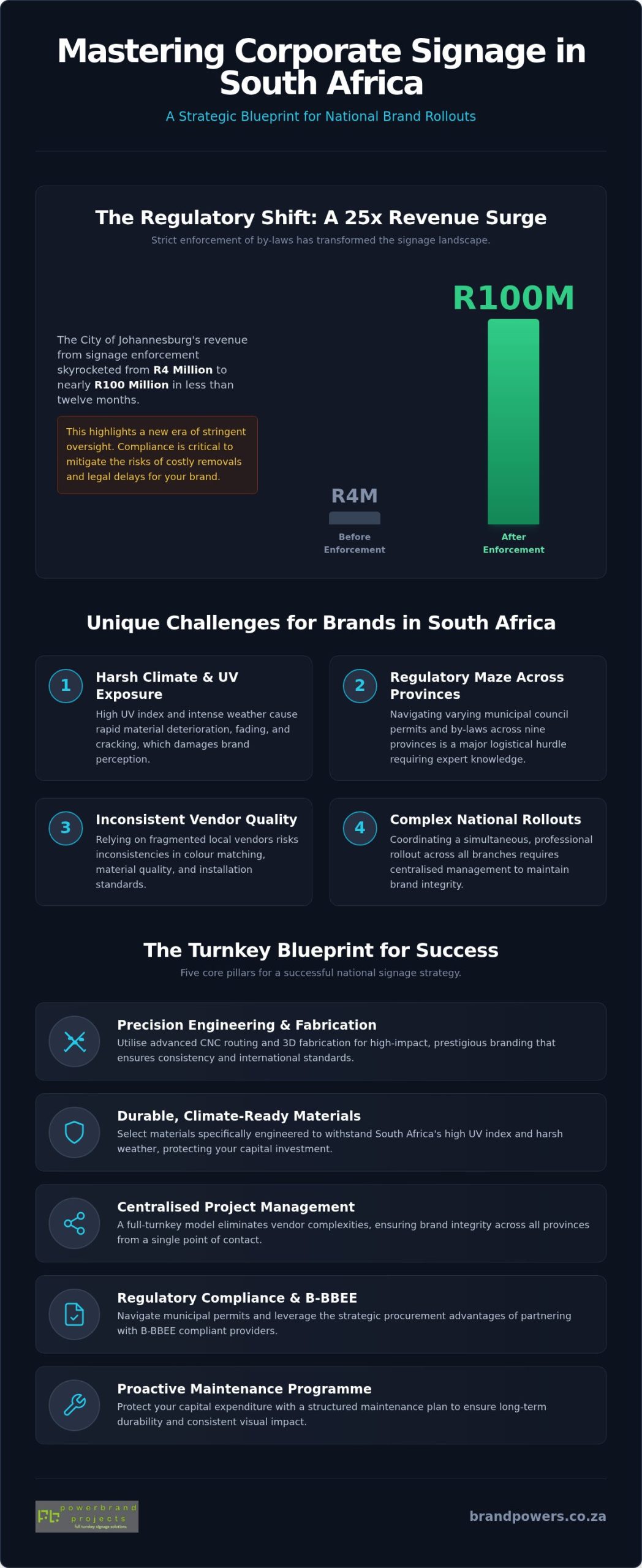
    Did you know that the City of Johannesburg’s recent enforcement of outdoor advertising by-laws saw municipal revenue from signage skyrocket from R4 million to nearly R100 million in less than twelve months? This surge reflects a new era of strict regulatory oversight that every executive must navigate when managing corporate signage South Africa. It’s no longer just about visibility; it’s about mitigating the risk of costly removals and legal delays while maintaining a prestigious brand presence across multiple provinces.

    We understand that coordinating a national rollout often feels like a logistical battle against harsh UV exposure, varying council permits, and inconsistent vendor quality. You likely want a strategy that ensures your brand remains durable and compliant without requiring constant micro-management. This definitive guide provides the blueprint for mastering strategic signage procurement and project management in 2026. We’ll examine how to streamline your installation process, select materials built for South African conditions, and partner with Level 4 BEE providers to ensure your visual identity remains a high-impact asset rather than a liability.

    Key Takeaways

    • Understand why premium external signage serves as a critical physical touchpoint for building consumer trust and establishing brand authority.
    • Gain insight into the technical precision of CNC routing and 3D fabrication to ensure your branding elements are manufactured to the highest international standards.
    • Learn how a full-turnkey project management model for corporate signage South Africa eliminates the complexity of coordinating multiple vendors across different provinces.
    • Navigate the essential regulatory requirements for national rollouts, from municipal council permits to the strategic procurement advantages of B-BBEE compliance.
    • Discover how a proactive maintenance programme protects your capital investment by ensuring long-term durability and consistent visual impact.

    The Strategic Role of Corporate Signage in the South African Business Landscape

    Corporate signage is often the first physical encounter a client has with your business. In a market as competitive as ours, this initial touchpoint determines the level of trust a consumer places in your brand. High-quality external signage acts as a silent ambassador; it communicates stability, professionalism, and attention to detail. Understanding the role and function of signage as a persuasive tool is essential for any executive looking to anchor their brand’s physical presence. It isn’t merely a decorative element. It’s a fundamental component of your corporate identity that bridges the gap between your digital promise and your physical reality.

    South African brands face a unique environmental challenge that many international guides overlook. Our high UV index and intense weather patterns mean that sub-standard materials deteriorate within months. Faded, peeling, or cracked signs don’t just look poor; they signal a lack of care for the brand’s identity. Executives should view corporate signage South Africa as a depreciating asset rather than a simple operational cost. By investing in durable fabrication and a structured maintenance programme, you ensure that this asset continues to reflect your brand’s prestige for years, providing a better long-term return on your capital expenditure.

    Beyond Aesthetics: Signage as Brand Infrastructure

    Pylon signs and billboards serve as permanent infrastructure that anchors your physical locations. They provide a sense of scale and permanence that digital marketing cannot replicate. When you utilise 3D fabricated lettering, you create a sense of depth and prestige that flat prints lack. This physical infrastructure must align perfectly with your digital presence to create a seamless brand experience. A well-placed pylon sign doesn’t just show people where you are; it establishes your company as a landmark within the local business community.

    The Complexity of National Brand Rollouts

    Maintaining brand integrity across nine provinces is a significant logistical hurdle. If you rely on fragmented local vendors, you risk inconsistencies in colour matching, material quality, and installation standards. A single, centralised partner ensures that your corporate signage South Africa looks identical in Polokwane as it does in Cape Town. This level of consistency is especially critical during corporate rebranding signage initiatives. A professional, simultaneous rollout across all branches maintains market confidence and ensures that your new identity is communicated with authority and precision from day one.

    Engineering Excellence: The Mechanics of Modern Signage Fabrication

    Precision engineering is the foundation of a successful brand presence. When we discuss corporate signage South Africa, we’re referring to a complex manufacturing process that transforms a digital logo into a physical, multi-dimensional asset. This transformation requires a blend of high-tech machinery and meticulous finishing. 3D fabrication has become the industry standard for prestigious branding because it adds depth and visibility that flat signs simply cannot achieve. This process involves creating individual letters or shapes that are then illuminated or mounted to create a high-impact visual statement.

    The technical rigour behind this work is vital. As noted in academic research on branding for South African SMEs, the quality of a company’s physical identity is a key driver of market perception. Using advanced tools like CNC machinery and laser cutters isn’t a luxury; it’s a requirement for maintaining brand authority. These technologies allow for the replication of intricate logos with mathematical accuracy, ensuring that your corporate identity remains consistent across every touchpoint.

    Advanced Manufacturing Technologies

    CNC routing allows for the cutting of various materials, including wood, plastics, and non-ferrous metals, with incredible speed and accuracy. This ensures that every component fits together perfectly during the assembly phase. Laser cutters are equally essential, particularly when dealing with high-grade acrylics or thin metal sheets where a polished, burr-free edge is required. For larger structures like pylon signs, welding and structural engineering are critical. These signs must be built to withstand the unique wind loads and environmental pressures found across South Africa’s diverse geography.

    Material Selection for the South African Climate

    Selecting the right materials is a strategic exercise in longevity. Aluminium is a favourite for external signage due to its natural resistance to rust, whilst high-grade acrylics provide the durability needed for internal and external displays. In our climate, the science of UV-resistant vinyl is particularly important. Standard prints often fade within a year under the South African sun, but UV-stabilised materials can last significantly longer. Additionally, we’ve transitioned almost exclusively to energy-efficient LED light boxes. These systems provide superior illumination while significantly reducing electricity consumption and maintenance needs.

    Achieving perfect colour accuracy is often the most difficult part of the process. Most corporate identities rely on specific Pantone or RAL shades that must look identical across different substrates. By maintaining in-house spray painting facilities, we can ensure that the finish on an aluminium pylon matches the acrylic lettering perfectly. This level of control prevents the inconsistencies that often occur when parts of a project are outsourced to different vendors. If you want to ensure your brand’s physical assets are built to last, exploring expertly engineered signage solutions is a prudent first step.

    The Turnkey Advantage: Why Project Management is Vital for National Branding

    Managing a national brand rollout requires more than just a fabrication partner; it demands a comprehensive project management framework. In the context of corporate signage South Africa, a full-turnkey solution refers to the seamless integration of design, in-house manufacturing, and nationwide installation. This approach eliminates the logistical friction caused by coordinating multiple local vendors who often use different materials or inconsistent colour-matching standards. By centralising production under one roof, we significantly reduce lead times and ensure that every pylon or light box meets the same rigorous quality benchmarks before it leaves the factory floor.

    Fragmented vendor networks often lead to diluted brand integrity. When you have a single point of contact, you gain total visibility over the project’s progress across all nine provinces. This centralised accountability is especially valuable during high-stakes corporate rebranding signage projects where timing is everything. A professional partner handles the complexities of logistics and manufacturing so your executive team can focus on broader strategic goals. It’s a process-driven strategy that transforms a complex infrastructure project into a predictable, manageable sequence of events.

    The Lifecycle of a Professional Signage Project

    A professional engagement begins long before the first piece of metal is cut. It starts with comprehensive site audits to determine the best placement for visibility and structural stability. Our team then translates 3D design concepts into technical shop drawings that account for every bolt and weld. This methodical planning ensures that manufacturing timelines align perfectly with your corporate deadlines. By managing the entire lifecycle, we prevent the common delays that occur when designs are handed off to third-party builders who may not understand the original technical requirements.

    Professional Installation Standards

    The final phase of any project is the most critical for public safety and brand reputation. Professional installation involves specialised rigging for heavy structures like billboards and pylons, which must comply with South African National Standards (SANS). Adhering to the Occupational Health and Safety Act (OHSA) is non-negotiable on any corporate site. Our project managers oversee every on-site detail to ensure that installations are completed safely and efficiently; this meticulous approach minimises business disruption whilst ensuring that your signage is structurally sound and fully compliant with national regulations.

    The Executive Guide to Corporate Signage in South Africa 2026

    Compliance and Standards: Navigating the Regulatory Framework in South Africa

    Compliance in the corporate signage South Africa sector has shifted from a secondary concern to a primary executive risk. Recent enforcement by the City of Johannesburg demonstrates this shift; their “No to Illegal Outdoor Advertising” campaign, launched in late 2025, increased municipal signage revenue from R4 million to nearly R100 million by July 2026. This aggressive stance on non-compliant billboards and pylons means that businesses can no longer afford to bypass formal channels. Beyond municipal bylaws, your physical branding must adhere to the South African National Standards (SANS) 1186 series for symbolic safety signs and the Occupational Health and Safety Act (OHSA) of 1993. These regulations ensure that your infrastructure is not only visible but legally and structurally sound.

    B-BBEE and Corporate Procurement

    Partnering with a Level 4 BEE signage company isn’t merely a matter of compliance; it’s a strategic procurement decision. Your signage spend directly influences your own corporate scorecard, making the choice of a verified partner essential for maintaining your B-BBEE status. We prioritise transparency in our certification to ensure that your procurement processes remain beyond reproach. This alignment supports broader economic transformation goals whilst ensuring you receive the high-tier engineering and project management your brand requires. It’s about building a supply chain that reflects your corporate values and legislative obligations.

    Navigating Council Bylaws and Permissions

    Every municipality maintains its own set of bylaws regarding outdoor advertising. For instance, the 2009 City of Johannesburg Outdoor Advertising By-Laws require formal applications for most external structures. Permit fees typically range from R500 to R5,000 depending on the sign’s type and the specific municipality involved. Managing these applications is a complex task that involves coordinating with urban planning departments to ensure compliance with traffic safety and environmental regulations. Signs that distract drivers or encroach on public spaces are now removed without hesitation, often at the owner’s expense. Ensuring your signage adheres to these local standards from the outset prevents costly legal battles and brand embarrassment. To understand how leading providers handle these regulatory complexities, reviewing a comprehensive guide to the best signage companies South Africa has available in 2026 can help you benchmark the right partner for your needs.

    Adhering to these standards requires a partner who understands the intersection of engineering and law. If you are planning a national rollout, ensure your next project is fully compliant by consulting with our regulatory experts to secure the necessary permits and certifications.

    Implementing a Sustainable Signage Strategy for Long-term Brand Impact

    A capital investment in corporate signage South Africa only delivers true value if the physical asset remains in peak condition throughout its intended lifecycle. Many executives mistakenly view the final installation as the conclusion of the project; however, the environmental reality of our climate demands a shift toward proactive maintenance. High UV levels and intense seasonal storms can degrade even the most robust materials if they are left unattended for years. By implementing a structured care programme, you protect the prestige of your brand whilst avoiding the sudden, large-scale costs associated with total system failure. It is a methodical approach that ensures your visual identity remains a high-impact asset rather than a neglected liability.

    Regular cleaning and electrical audits are the most effective ways to extend the life of your signage infrastructure. Whilst LED technology is highly durable, local power fluctuations and thermal stress can impact performance over time. A professional maintenance schedule allows for the early detection of minor issues before they necessitate a full replacement. In many cases, a well-manufactured sign can be refurbished with new vinyl or updated lighting components at a fraction of the cost of a new pylon. This modular approach ensures your branding remains modern and effective without requiring a total reinvestment every few years. It’s about making a cost-effective choice that balances immediate aesthetics with long-term fiscal responsibility.

    Maximising Longevity through Maintenance

    The South African climate is particularly harsh on illuminated external signage. Constant exposure to direct sunlight causes standard pigments to fade; meanwhile, dust accumulation on light boxes can lead to overheating and reduced LED efficiency. Scheduled inspections for structural integrity are vital, especially for large-scale pylons that must remain compliant with SANS safety standards. A professional maintenance contract provides the reassurance that your physical assets are being monitored by experts who understand the engineering behind the fabrication. This proactive oversight prevents the gradual decay that can quietly undermine your brand’s professional image.

    Selecting the Right Partner for the Future

    Choosing a signage partner is a strategic decision that affects your brand’s physical presence for years. You should evaluate potential providers based on their in-house manufacturing capacity and their Level 4 BEE status to ensure both quality and procurement compliance. A partner that offers site-specific recommendations during the design phase will help you avoid environmental pitfalls. Before awarding a national tender, executives should verify the following criteria:

    • Does the provider possess in-house CNC and laser cutting technology for precision?
    • Is there a documented history of successful national rollouts across different provinces?
    • Can they provide proof of current B-BBEE verification and adherence to SANS safety standards?
    • Do they offer a comprehensive, turnkey maintenance and repair service?

    This final checklist ensures that your brand infrastructure is handled with the precision, reliability, and technical expertise it deserves.

    Securing Your Brand’s Physical Future

    Mastering the complexities of corporate signage South Africa requires a disciplined approach that balances engineering excellence with rigorous project management. We’ve established that a successful national rollout depends on more than just aesthetics; it demands a partner capable of navigating municipal bylaws, maintaining B-BBEE compliance, and ensuring structural integrity against the local climate. By centralising your fabrication and installation under a single professional framework, you eliminate the risks of vendor fragmentation and ensure your corporate identity remains consistent from the boardroom to the street level.

    As a Level 4 BEE Certified Partner with a full in-house manufacturing suite and national installation capability, Power Brand Projects provides the stability and expertise your executive team requires. We handle the technical logistics so you can focus on your broader strategic goals. We invite you to Request a Professional Consultation with Power Brand Projects to begin planning your next high-impact branding initiative. It’s time to invest in a visual presence that truly reflects the prestige and reliability of your business. We look forward to partnering with you on your journey toward brand excellence.

    Frequently Asked Questions

    How long does a typical corporate signage project take to complete?

    A standard project typically requires four to eight weeks from the final design approval to the completion of on-site installation. Larger national rollouts for corporate signage South Africa may follow a staggered timeline over several months to maintain quality across different provinces. This schedule accounts for the creation of technical shop drawings, material procurement, and our rigorous in-house manufacturing process.

    Do I need council permission for all types of external signage in South Africa?

    Formal council approval is mandatory for most external signs that are visible from a public road or space. Municipalities, such as the City of Johannesburg, enforce strict outdoor advertising bylaws to ensure public safety and urban order. We assist in managing the application process to help you secure the necessary permits for structures like billboards, pylons, and large-scale building wraps.

    What are the benefits of 3D fabricated signs over traditional flat signs?

    3D fabricated signs offer superior visibility and a sense of brand prestige that flat signs cannot replicate. By adding physical depth and utilizing internal LED illumination, these signs create a high-impact presence that remains legible from greater distances. This multi-dimensional approach effectively communicates the scale and stability of a corporate entity to your clients.

    Why is a Level 4 BEE rating important when choosing a signage company?

    A Level 4 BEE rating ensures that your signage expenditure contributes positively to your own company’s preferential procurement scorecard. Partnering with a verified provider simplifies your annual audit process and demonstrates a commitment to economic transformation in South Africa. It’s a strategic procurement choice that aligns your branding requirements with national legislative standards.

    Can you handle signage installation for multiple branches across South Africa?

    We provide comprehensive installation services across all nine provinces to support absolute brand consistency for national rollouts. Our project management team coordinates all logistics and specialised rigging crews to ensure that every branch meets the same technical standards. This centralised approach eliminates the logistical burden of managing multiple local vendors in different regions.

    What type of maintenance is required for illuminated light boxes?

    Maintenance for illuminated light boxes involves bi-annual cleaning of the face panels and annual electrical audits. Dust and environmental debris can reduce illumination levels and lead to thermal stress on the internal components over time. Regularly checking the integrity of the LED modules and power supplies ensures your sign remains bright and energy-efficient for its entire lifespan.

    What is the difference between a pylon sign and a billboard?

    A pylon sign is a permanent, on-site structure used to identify a specific business location, whilst a billboard is typically used for third-party advertising on high-traffic routes. Pylons serve as essential physical landmarks for your premises; billboards focus on broader brand awareness campaigns. Both structures require specialised engineering and council permissions to ensure they meet SANS safety standards.

    How do you ensure brand colour consistency during the manufacturing process?

    We ensure absolute colour consistency by using in-house spray painting facilities and precision Pantone matching across all substrates. Whether we’re working with acrylic, aluminium, or vinyl, our technical team verifies that every component aligns with your corporate identity guidelines. This methodical control over the finishing process prevents the colour variations that often occur when projects are outsourced to multiple vendors.